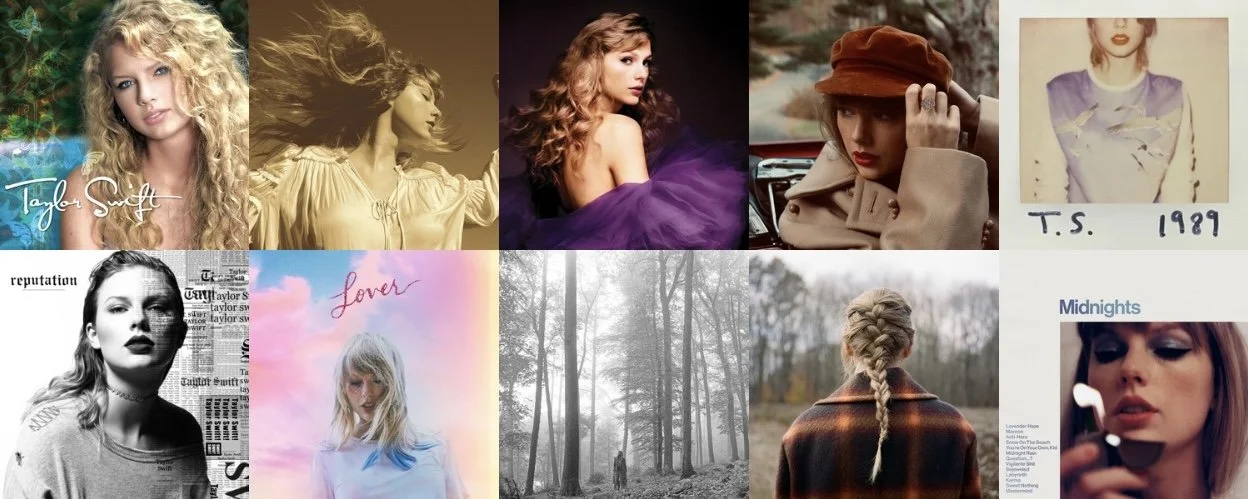
Taylor Swift’s discography began with country songwriting in 2006 and eventually moved through pop, indie folk and alternative sounds. By 2025, her catalogue had reached 12 studio albums, alongside four re-recorded “Taylor’s Version” albums.
The beginning: Taylor Swift
Taylor Swift’s self-titled debut arrived in 2006. It introduced a teenage songwriter whose music was rooted in country but already showed the personal storytelling that would become her defining trademark.
Songs such as “Tim McGraw” established the pattern. Swift wrote about specific emotions, relationships and memories rather than relying on generic country themes.
The album was the starting point for a catalogue that would eventually stretch across multiple genres.
Fearless changed the scale
In 2008, Swift released Fearless. It was still connected to country music, but its songwriting and production pushed her toward a much larger mainstream audience.
The album became one of the defining releases of her early career. It included “Love Story” and “You Belong With Me,” songs that helped make Swift a major name beyond the country market.
Years later, Swift returned to the album through Fearless (Taylor’s Version), part of her campaign to regain control over recordings of her earlier work. The official Taylor Swift archive lists both versions separately.
Speak Now: the songwriter takes control
Speak Now arrived in 2010. It represented an important development because Swift wrote the album herself.
That fact became significant when examining her discography retrospectively. The album demonstrated that her songwriting was not simply part of a production team or co-writing system.
Songs including “Mine,” “Back to December” and “Mean” expanded the emotional range of her writing.
Speak Now (Taylor’s Version) was released in 2023, continuing the re-recording project that had become an important part of Swift’s catalogue.
Red marked the transition
With Red in 2012, the boundaries around Swift’s music became harder to define.
The album combined country influences with pop, rock and electronic production. “We Are Never Ever Getting Back Together” and “I Knew You Were Trouble” demonstrated how naturally Swift could move toward mainstream pop.
The original Red was followed by Red (Taylor’s Version) in 2021. The re-recorded edition also contained previously unreleased “From the Vault” songs, giving listeners material that had not appeared on the original album.
1989 was the major pop transformation
Then came 1989 in 2014.
This was the moment when Swift fully embraced pop as the dominant language of her music. The album produced major singles including “Shake It Off,” “Blank Space” and “Style.”
The title itself referenced the year of Swift’s birth, while the music looked deliberately toward 1980s-inspired pop.
The album’s success confirmed that the move away from country was not a temporary experiment.
In 2023, Swift released 1989 (Taylor’s Version). It became the fourth album to receive the “Taylor’s Version” treatment after Fearless, Red and Speak Now.
Reputation changed the narrative
Reputation arrived in 2017 after a period of intense public scrutiny around Swift.
The album presented a darker image. “Look What You Made Me Do” became its most obvious statement, while songs such as “Delicate” revealed a more private side beneath the deliberately aggressive presentation.
The album remains one of the clearest examples of Swift turning public controversy into a creative concept.
Unlike Fearless, Red, Speak Now and 1989, Reputation had not been re-recorded as a “Taylor’s Version” in the discography listed by Swift’s official archive.
Lover opened another chapter
In 2019, Swift released Lover.
The album moved away from the darker atmosphere of Reputation and embraced brighter colours, romance and vulnerability. “Me!” and “You Need to Calm Down” represented its more outward-facing pop side, while “Lover” became one of its central emotional songs.
It was also significant because it was the last of Swift’s pre-pandemic studio albums.
folklore and evermore changed everything again
Swift surprised listeners in 2020 with folklore. The album moved toward indie folk, alternative and stripped-back songwriting.
The change was substantial. Instead of building around the conventional pop-single structure, Swift created fictional characters and interconnected stories.
Later that same year came evermore, which continued many of the musical ideas introduced by folklore.
These two albums showed that Swift’s discography could move in a completely different direction without losing its identity.
Midnights returned to pop
In 2022, Swift released Midnights.
The project explored sleepless nights, memories, insecurity and self-reflection. Its lead single, “Anti-Hero,” became one of the most recognisable songs from the era.
The album also arrived during the period in which Swift’s career was increasingly being understood through the concept of separate “eras.”
Her official website now presents an archive organised around these eras, from the debut through Midnights and beyond.
The Tortured Poets Department
Swift’s next studio album was The Tortured Poets Department, released in 2024.
The project continued her interest in deeply personal songwriting while expanding the darker and more literary qualities heard in earlier work.
Its lead single “Fortnight,” featuring Post Malone, became one of the key tracks associated with the album.
The official Taylor Swift archive lists The Tortured Poets Department among her major album eras.
The Life of a Showgirl adds another chapter
The latest major addition to the catalogue is The Life of a Showgirl. Swift’s official website currently lists it as an album era, while her official store identifies editions containing 12 tracks.
That makes the development of Swift’s discography unusually easy to trace. The country beginnings are still visible, but they sit alongside synth-pop, mainstream pop, indie folk and more experimental songwriting.
What makes Taylor Swift’s discography different?
The interesting part is not simply the number of albums.
It is the number of times Swift has rebuilt her musical identity without abandoning the central idea that made her successful: detailed songwriting.
From Taylor Swift to The Life of a Showgirl, each era has introduced a different version of the artist. Some changes were gradual. Others were dramatic.
The re-recordings add another layer. Fearless (Taylor’s Version), Red (Taylor’s Version), Speak Now (Taylor’s Version) and 1989 (Taylor’s Version) are not ordinary catalogue reissues. They form part of Swift’s larger effort to reclaim ownership of her earlier recordings.
The result is a discography that functions almost like a timeline of Swift’s career.
The mystery behind the catalogue is therefore not which genre defines Taylor Swift. The evidence suggests that no single genre does. Her defining feature is the ability to change the music while keeping the songwriting unmistakably hers.