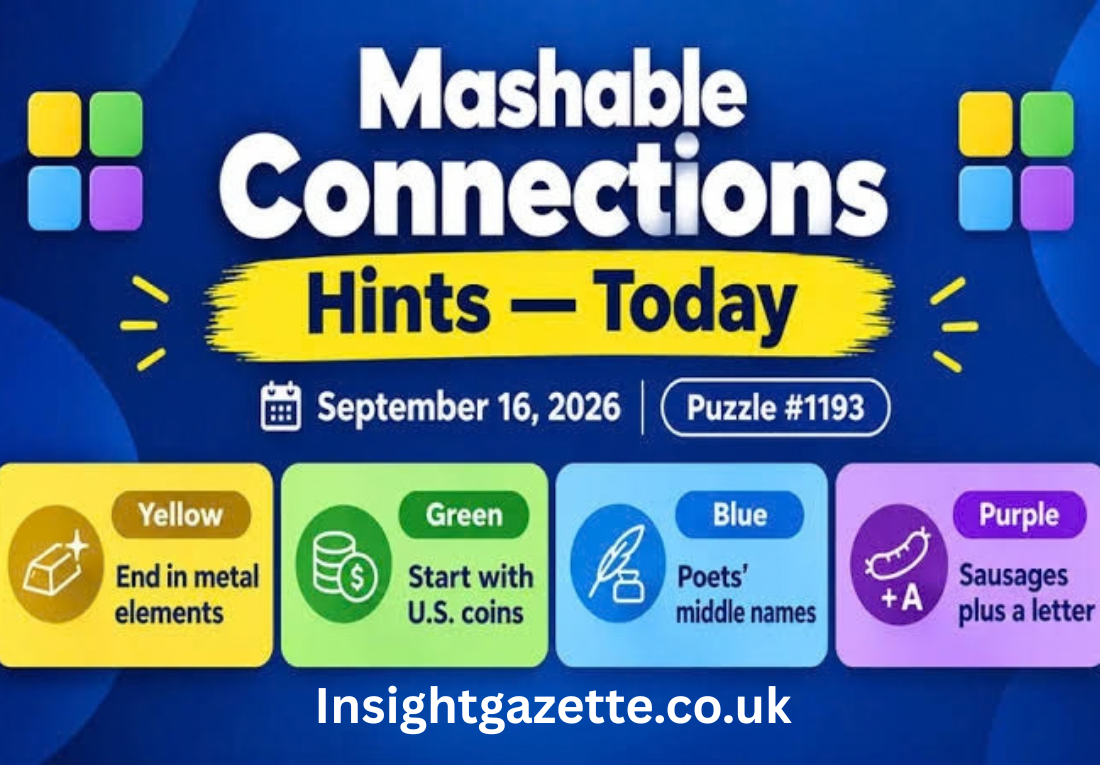
Finding the right Mashable Connections hints today can make the difference between solving the daily puzzle independently and getting stuck on a misleading word association. The September 24, 2026 puzzle challenges players to organize 16 words into four groups of four. Today’s themes include vampire-costume elements, things involving springs, items featuring pointing, and anagrams, offering a mix of familiar clues and wordplay.
What Is the NYT Connections Puzzle?
Connections is a daily word game from The New York Times in which players receive a grid of 16 words and must identify four groups containing four related words. The relationships can involve meanings, phrases, objects, names, cultural references, spelling patterns, or wordplay.
The challenge is that several words can appear to belong together. A word such as “cape,” for example, could potentially fit several themes depending on the surrounding words. The puzzle therefore rewards players who look for a complete group rather than immediately committing to the first association they notice.
The four groups are traditionally represented by yellow, green, blue, and purple difficulty levels. Yellow is generally the most straightforward, while purple tends to involve more complicated wordplay.
Mashable Connections Hints Today: The Four Broad Clues
For September 24, Mashable’s reported category hints are intentionally brief: “Bloodsuckers,” “Boing!,” “Hey, you!” and “Same letters.” These clues point toward the four underlying categories without immediately revealing every answer.
This approach is useful because Connections is designed around gradual discovery. If you reveal the complete answer too early, you lose the opportunity to recognize the pattern yourself.
The four category concepts reported for today’s puzzle are parts of a vampire costume, things with spring/s, featuring pointing, and anagrams.
Today’s Connections Categories Explained
The yellow group focuses on recognizable components associated with a vampire costume. The relevant words are CAPE, FACE PAINT, FAKE BLOOD, and FANGS. This is an example of a semantic category because the words relate through a common theme rather than a spelling rule.
The green group is things with spring/s, containing BOBBLEHEAD, POGO STICK, SNAKES IN A CAN, and TRAMPOLINE. These objects all involve springs in their construction or operation, although their purposes are completely different.
The blue category, featuring pointing, contains CREATION OF ADAM, FOAM FINGER, I’M WITH STUPID SHIRT, and UNCLE SAM. This is more visual and conceptual than the first two categories, which makes it easier to overlook when scanning the board.
The purple group is anagrams: BEER HAT, BREATHE, HERB TEA, and THE BEAR. These phrases become connected through rearranged letters, making this category particularly dependent on noticing spelling relationships rather than simply interpreting word meanings.
A Quick Comparison of Today’s Puzzle Categories
| Category | Difficulty Style | Connection Type | Example |
|---|---|---|---|
| Parts of a vampire costume | Yellow | Common theme | CAPE |
| Things with spring/s | Green | Physical objects | POGO STICK |
| Featuring pointing | Blue | Visual/conceptual | FOAM FINGER |
| Anagrams | Purple | Letter manipulation | THE BEAR |
The important lesson is that Connections categories can operate at completely different levels. One group may be based on physical objects, another on visual imagery, and another on the arrangement of letters.
Why Connections Can Feel Difficult
The main difficulty is not recognizing relationships. It is recognizing the correct relationship.
A player may immediately notice that two or three words appear related, but that does not necessarily mean they belong in the same group. Connections deliberately includes misleading associations, often called red herrings.
For example, several words might be associated with entertainment, sports, clothing, or food. However, if four words can be connected by a much more precise pattern, that pattern is usually more useful.
A good strategy is to search for four words that share the same relationship rather than simply finding pairs.
How to Use Mashable Connections Hints Without Spoiling the Game
The most effective way to use daily hints is progressively.
Start by looking at the 16 words yourself. Identify obvious relationships and mentally group possible combinations. If you become stuck, use a category-level hint rather than immediately checking the complete solution.
For today’s puzzle, “Bloodsuckers” gives a direction without directly saying “vampire costume.” Likewise, “Boing!” suggests springs without naming the category. The other clues similarly provide conceptual nudges.
This preserves much of the solving experience while reducing frustration.
Cloud Architecture Lessons Hidden in a Word Puzzle
Although Connections is a word game, its structure provides an interesting analogy for cloud architecture.
In a complex cloud environment, individual components can have multiple relationships. An application might communicate with a database, identity service, monitoring platform, API gateway, and storage system. Simply identifying connections is not enough; architects need to understand which dependencies belong to the same functional architecture.
Connections works similarly. Individual words may have multiple apparent relationships, but the goal is to identify the relationship that creates a complete group.
For example, an enterprise application could separate workloads into presentation, application, data, and analytics layers. Each layer has a distinct purpose, even though all four participate in the same overall system.
Scalability, Security, and Cost in Digital Puzzle Platforms
A popular daily puzzle must also operate reliably for a large online audience. From a cloud architecture perspective, this requires scalable infrastructure capable of handling traffic spikes when players begin solving a new puzzle.
A typical architecture could place web applications behind load balancers and use horizontally scalable application servers. Static resources can be distributed through a content delivery network, while databases can use replication and automated backups.
Security is equally important. User accounts, authentication information, game statistics, and payment-related information where applicable should be protected using encryption, strong identity controls, least-privilege access, and continuous monitoring.
Cost optimization also matters. A platform should scale resources according to demand instead of permanently operating at peak capacity. Autoscaling and efficient storage policies can help balance performance with infrastructure spending.
Common Mistakes When Solving Connections
One frequent mistake is locking onto a category too early. Finding three apparently related words can create false confidence, especially when the fourth word is difficult to justify.
Another mistake is ignoring word structure. Some Connections categories depend on letters, prefixes, suffixes, rearrangements, or phrases rather than meanings.
Players can also overlook visual or cultural relationships. Today’s “featuring pointing” category demonstrates how a relationship can depend on imagery rather than straightforward definitions.
A better method is to test every proposed group against the entire board. If one word feels forced, continue searching.
Future of Daily Word Games and Digital Puzzles
Daily word games increasingly combine simple interfaces with sophisticated content systems. Behind a seemingly simple puzzle experience can be a content-management platform, user-account infrastructure, analytics pipeline, recommendation system, advertising technology, and scalable delivery network.
Future puzzle platforms may use richer personalization, accessibility features, cross-device synchronization, and increasingly sophisticated content delivery. From an infrastructure perspective, these developments create requirements for scalable APIs, resilient databases, observability, and secure identity management.
The underlying principle remains the same: the technology should stay largely invisible to the player while delivering a fast and reliable experience.
Frequently Asked Questions
1. What are today’s Mashable Connections hints?
For September 24, 2026, Mashable’s reported clue-style hints are Bloodsuckers, Boing!, “Hey, you!”, and Same letters.
2. What are today’s Connections categories?
The reported categories are Parts of a vampire costume, Things with spring/s, Featuring pointing, and Anagrams.
3. What are the answers for today’s Connections puzzle?
The four groups are CAPE, FACE PAINT, FAKE BLOOD, FANGS; BOBBLEHEAD, POGO STICK, SNAKES IN A CAN, TRAMPOLINE; CREATION OF ADAM, FOAM FINGER, I’M WITH STUPID SHIRT, UNCLE SAM; and BEER HAT, BREATHE, HERB TEA, THE BEAR.
4. Why is the purple Connections group usually difficult?
Purple groups frequently depend on less obvious wordplay. In today’s puzzle, the category is based on anagrams, meaning players must notice relationships between rearranged letters rather than simply looking for shared meanings.
5. How can beginners improve at Connections?
Start with the most obvious category, look for four-word relationships instead of isolated pairs, and be cautious about red herrings. When a group almost works but one word feels forced, reconsider the category before submitting it.
Conclusion
Today’s Mashable Connections hints today guide players toward four very different types of relationships: vampire-costume elements, spring-related objects, pointing imagery, and anagrams. The puzzle demonstrates why Connections is more challenging than a simple vocabulary exercise: successful solving requires semantic reasoning, visual recognition, cultural knowledge, and attention to word structure.
For beginners, the best approach is to treat hints as guidance rather than immediate answers. Examine the entire board, test potential groups carefully, and save the most abstract category for later. Whether viewed as a daily word challenge or as an example of structured problem-solving, Connections rewards the same fundamental skill that good technology architecture requires—recognizing meaningful relationships within a complex system.