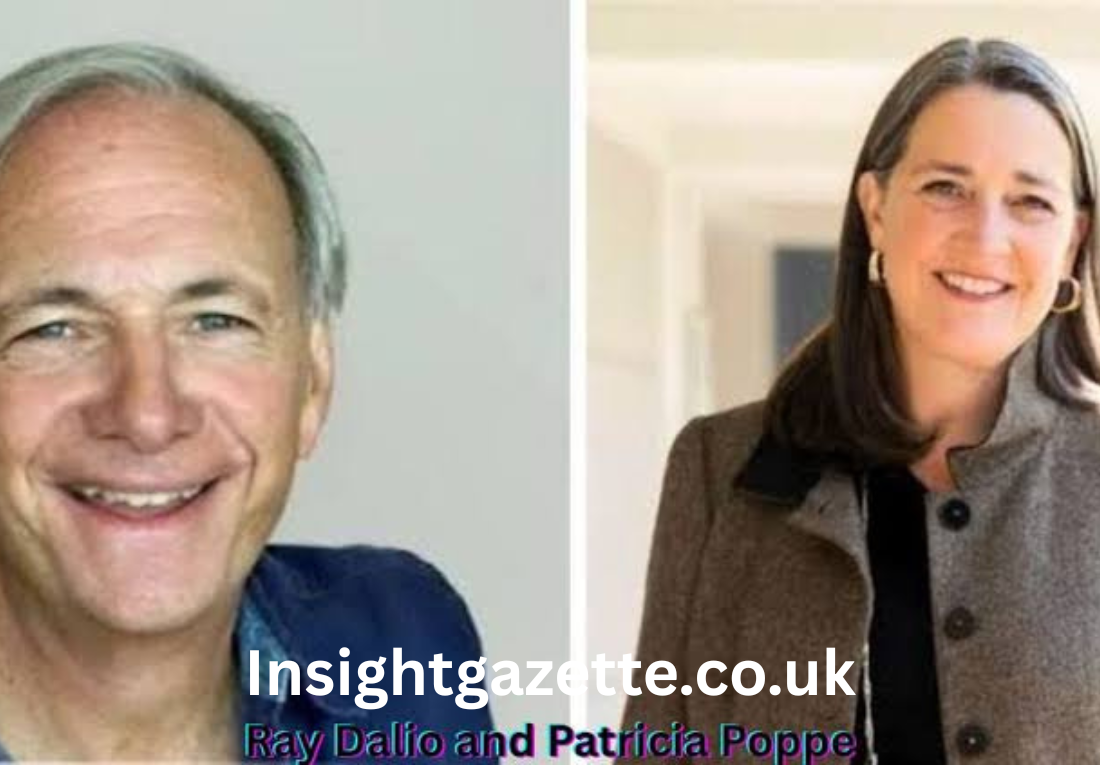
Ray Dalio built Bridgewater Associates from a small operation into one of the world’s best-known investment firms. Patricia “Patti” Poppe took a different route, moving through manufacturing and energy leadership before becoming CEO of PG&E Corporation. Their names now appear together for a specific reason—but it is not the personal connection some searches may suggest.
The Question Behind the Two Names
At first glance, Ray Dalio and Patricia Poppe seem to belong to completely different professional worlds. Dalio is associated with investment management, economic research and Bridgewater, while Poppe is known for corporate leadership in the energy sector.
Public records reviewed for this article do not establish that Dalio and Poppe are relatives, business partners, colleagues or personal collaborators. No official source confirms a direct relationship between them.
The documented link is more indirect. It involves Bridgewater Associates and PG&E Corporation, the company Poppe has led since January 2021.
Ray Dalio’s Bridgewater Story
Dalio founded Bridgewater in 1975 from his apartment. According to Bridgewater’s official biography, he later served as CEO, CIO and chairman before handing the firm to a new generation of leaders.
He stepped down as CEO in 2017, as CIO in 2020 and as chairman at the end of 2021. Bridgewater now describes his role as focused primarily on mentoring people at the firm and beyond.
That timeline matters when examining the Poppe connection. A current Bridgewater investment should not automatically be described as a personal investment made by Dalio.
Patricia Poppe’s Career Took Another Route
Poppe’s career developed in manufacturing and energy rather than finance. PG&E’s 2026 SEC filing identifies her as chief executive officer of PG&E Corporation, a position she assumed in January 2021.
The same filing distinguishes PG&E Corporation from its regulated utility subsidiary, Pacific Gas and Electric Company. As of January 1, 2026, Sumeet Singh was serving as the utility’s sole principal executive officer, while Poppe remained CEO of PG&E Corporation.
This distinction is important because online profiles sometimes merge the two corporate roles.
The Bridgewater-PG&E Connection
The most concrete connection appears in investment filings.
Bridgewater Associates reported holding 24,531 shares of PG&E Corporation at the end of the first quarter of 2026. By June 30, 2026, its reported position had risen to 5,931,314 shares, valued at approximately $99.8 million at quarter-end.
Those figures create an obvious reason for the two names to appear in the same research trail.
But there is an important line between Bridgewater investing in PG&E and Ray Dalio personally investing in PG&E.
The filing identifies Bridgewater Associates as the institutional investment manager. It does not establish that Dalio personally purchased the shares, personally selected the position or instructed the firm to make the investment.
Any claim otherwise is working from an assumption that the filing itself does not prove.
Was Poppe Working With Dalio?
No official source reviewed for this article establishes that Poppe worked directly with Dalio.
There is also no verified evidence that Dalio advised Poppe, that Poppe advised Bridgewater, or that the two executives formed a private business partnership.
Their professional paths simply intersect through corporate institutions.
Dalio’s documented history centers on investment management and Bridgewater. Poppe’s record centers on manufacturing, energy and PG&E leadership. The similarity is that both became senior figures in large organizations—not that they built those organizations together.
Why the Distinction Matters
This is where the story becomes easier to understand.
A large investment firm can own shares in a public company without its founder personally owning those shares. Institutional filings are designed to disclose investment positions held under an investment manager’s discretion.
The June 2026 Bridgewater position therefore tells us something concrete about Bridgewater’s portfolio. It does not tell us what Dalio personally believed about PG&E, nor does it prove that Poppe and Dalio had conversations about the company.
That missing information should remain missing rather than being filled with speculation.
Two Very Different Leadership Histories
Dalio’s career is closely associated with systematic approaches to investing, economic analysis and the development of Bridgewater’s distinctive organizational culture.
Poppe’s career has been shaped by operational leadership. Her current position places her at the head of PG&E Corporation, where corporate strategy, energy infrastructure, regulation and customer issues form part of the company’s public responsibilities.
The contrast is striking, but it is not evidence of a personal connection.
What the Public Record Actually Shows
The timeline is relatively straightforward.
Dalio founded Bridgewater in 1975 and gradually transferred leadership responsibilities before stepping away from his formal senior roles. Poppe became CEO of PG&E Corporation in January 2021 and remains in that role according to the company’s 2026 filings.
Bridgewater subsequently reported a significant PG&E share position in its second-quarter 2026 filing. That is the strongest documented institutional link between the two names.
There is no reliable public evidence in the sources reviewed that turns that institutional overlap into a personal partnership.
Final Thoughts
Ray Dalio and Patricia Poppe have two separate career stories that happen to intersect through a publicly reported investment.
The evidence supports a Bridgewater-PG&E connection. It does not establish a direct relationship between Dalio and Poppe themselves. That distinction resolves the mystery: the link is institutional, not a confirmed personal or professional partnership.
Author Bio:
Written by an investigative business and human-interest journalist specializing in executive profiles, corporate histories and fact-checking. The focus is on separating documented records from assumptions surrounding well-known public figures.