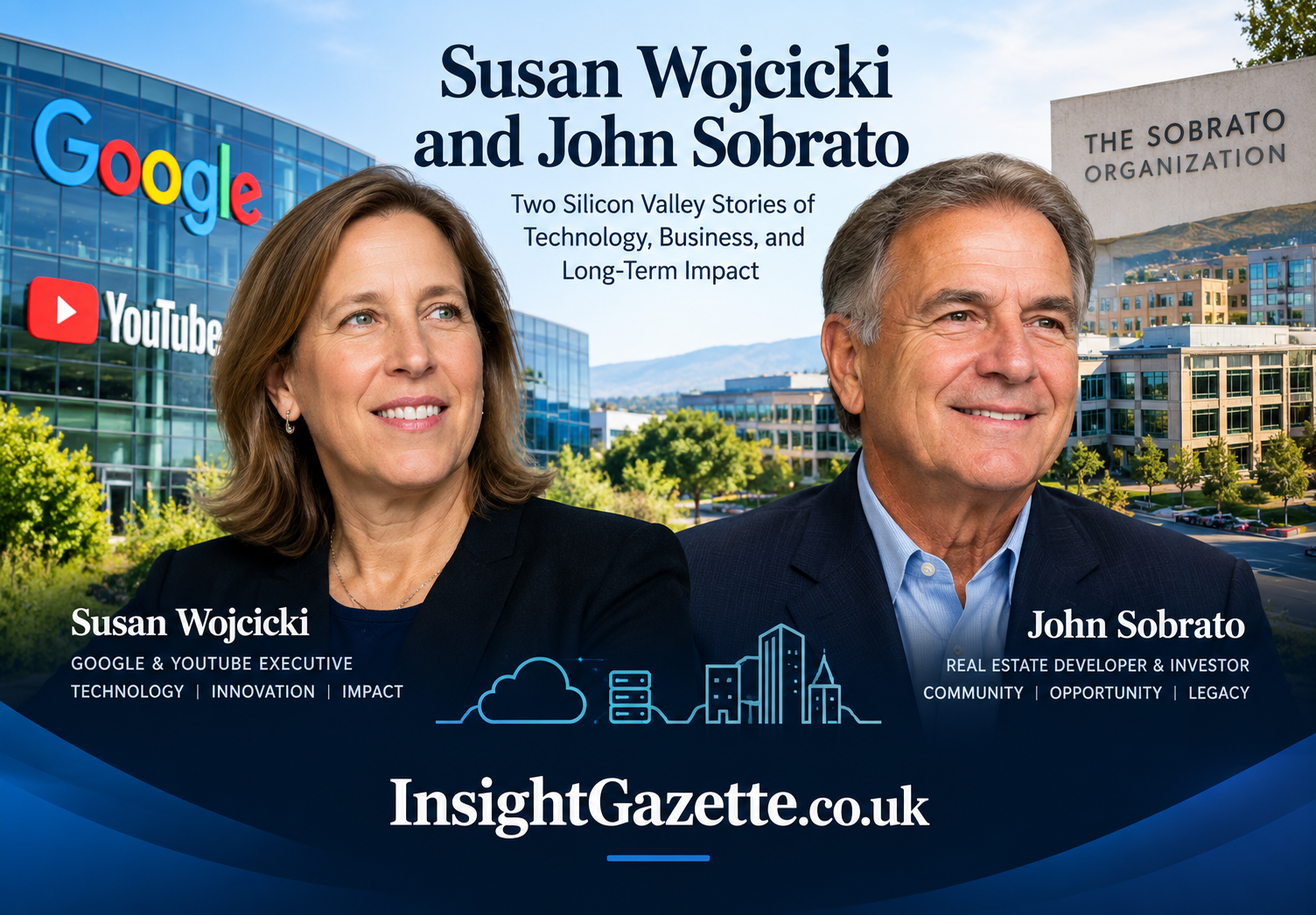
Susan Wojcicki and John Sobrato represent two very different paths through Silicon Valley’s transformation. Wojcicki became a major technology executive, helping shape Google’s advertising business and later leading YouTube, while Sobrato built a major real-estate business serving the technology industry and developed a substantial philanthropic legacy. Their careers offer useful lessons about scalable organizations, infrastructure, leadership, investment, and long-term community impact.
Who Were Susan Wojcicki and John Sobrato?
Susan Wojcicki was a technology executive best known for her leadership at Google and YouTube. She joined Google in 1999 as its first marketing manager and later became Senior Vice President of Advertising & Commerce. In 2014, she became YouTube’s CEO, a position she held through 2023. She was also instrumental in Google’s 2006 acquisition of YouTube.
John Albert Sobrato followed a substantially different route. He entered real estate while studying at Santa Clara University and later founded Midtown Realty before concentrating on commercial development. His organization became deeply connected to the growth of Silicon Valley’s technology economy.
Although their industries differed, both stories demonstrate how long-term infrastructure can support growth. Wojcicki worked with digital platforms and advertising systems, while Sobrato developed physical environments used by technology companies.
Susan Wojcicki’s Role in the Growth of Google and YouTube
Wojcicki’s career illustrates how technology businesses can evolve from relatively small operations into globally scaled platforms.
At Google, she worked on advertising products including AdWords, AdSense, DoubleClick, and Google Analytics. These systems helped businesses connect digital audiences with advertising, creating infrastructure that could operate across enormous numbers of users and transactions.
Her involvement with YouTube was particularly significant. She recognized the potential of online video and supported Google’s acquisition of YouTube in 2006. As CEO beginning in 2014, she oversaw content, engineering, product development, and business operations.
From a cloud-architecture perspective, YouTube demonstrates the importance of distributed infrastructure. A platform serving users around the world requires scalable storage, content delivery, data processing, security controls, monitoring, and highly available services.
John Sobrato and Silicon Valley’s Physical Infrastructure
John Sobrato’s contribution to Silicon Valley developed through commercial real estate rather than software. His company built properties for technology businesses during the region’s rapid expansion.
The Sobrato Organization’s history includes development associated with technology companies and major corporate campuses. Santa Clara University notes that the organization developed properties for companies including Apple, Nvidia, Netflix, EMC, VeriSign, and Yahoo!.
This provides an interesting infrastructure comparison. Digital businesses require servers, networks, databases, and cloud platforms, but they also depend on physical locations, offices, research facilities, housing, transportation, and utilities.
In that sense, the growth of Silicon Valley can be understood as an interconnected infrastructure system rather than simply a collection of software companies.
A Cloud Architecture Perspective on Their Careers
A modern cloud architect typically thinks about systems in layers. Applications sit on computing infrastructure, data services support applications, networks connect users, and security controls protect everything.
The careers of Wojcicki and Sobrato can be viewed through a similar systems perspective.
| Area | Susan Wojcicki | John Sobrato |
|---|---|---|
| Primary field | Technology and digital media | Real estate and investment |
| Major platform | Google and YouTube | Sobrato Organization |
| Infrastructure focus | Digital platforms and advertising systems | Commercial and residential properties |
| Growth model | Global digital scalability | Physical development and investment |
| Key ecosystem | Creators, advertisers and internet users | Technology companies, communities and institutions |
| Philanthropic emphasis | Education, women in technology and later health research | Education, housing, health care and economic mobility |
| Long-term lesson | Build platforms that scale | Build infrastructure that enables communities and businesses |
The comparison does not mean the two careers were identical. Rather, it highlights how different forms of infrastructure can create economic and social value.
Scalability: Digital Platforms vs. Physical Development
Scalability is one of the most important concepts in cloud computing.
A digital platform can potentially add computing capacity as demand increases. For example, a video service can distribute content through global networks and dynamically allocate computing resources. However, scalability introduces challenges involving latency, storage costs, cybersecurity, reliability, and data management.
Real estate scales differently. A developer must acquire land, obtain approvals, finance construction, build facilities, and manage long-term assets. Physical expansion is slower but can create durable infrastructure.
Wojcicki’s YouTube experience illustrates digital scalability, while Sobrato’s development career illustrates physical scalability. Both require careful capital allocation, operational planning, risk management, and understanding of future demand.
Security, Reliability, and Risk Management
Security is essential for technology platforms. A large digital service needs identity management, access controls, encryption, monitoring, incident response, backup systems, and appropriate data-governance practices.
Reliability is equally important. Cloud architects commonly design for redundancy so that a failure in one component does not bring down the entire service. Distributed architectures can use multiple regions, replicated data, automated failover, and continuous monitoring.
Physical infrastructure has different security requirements. Commercial properties require physical access controls, surveillance, emergency systems, building maintenance, and resilience planning.
The broader lesson from both careers is that successful infrastructure is rarely visible when everything works correctly. Its value becomes most obvious when organizations must respond to disruption.
Philanthropy and Community Investment
The stories of Wojcicki and Sobrato also extend beyond business.
The Susan Wojcicki Foundation describes her as an advocate for education, women in technology, parental leave, and later lung-cancer research. After her death in 2024, the foundation continued work focused on research, early detection, prevention, and education.
The Sobrato family has developed a broad philanthropic platform covering affordable housing, education, health care, humanitarian assistance, and economic mobility.
John and Susan Sobrato also made a $100 million gift to Santa Clara University to establish the Sobrato Campus for Discovery and Innovation, supporting STEM education.
This demonstrates an important principle in long-term organizational strategy: capital can be used not only to grow businesses but also to strengthen the ecosystems in which communities operate.
Cost Considerations and Sustainable Growth
Cost management is another area where the two stories offer useful business lessons.
In cloud architecture, organizations must balance performance against infrastructure costs. Running unnecessary computing resources, storing redundant data indefinitely, or designing inefficient systems can increase expenses. Effective architecture uses automation, resource monitoring, appropriate storage tiers, and demand-based scaling.
Real estate has an equivalent challenge. Property development requires substantial capital, while operating costs continue after construction. Successful organizations therefore need to consider location, utilization, financing, maintenance, market demand, and long-term asset value.
Sobrato’s recent emphasis on affordable housing illustrates how investment priorities can evolve with changing community needs. In 2026, the Sobrato Organization opened The Millton in Redwood City, a 120-unit affordable housing project, as part of a broader housing strategy.
What Their Careers Teach Modern Business Leaders
The comparison between Susan Wojcicki and John Sobrato provides several broader lessons.
First, infrastructure matters. Wojcicki’s career shows how digital infrastructure can support billions of interactions, while Sobrato’s career demonstrates how physical infrastructure can support technology companies and communities.
Second, organizations need to adapt. Digital platforms change rapidly, while real estate operates on much longer cycles. Both environments require leaders to understand changing demand rather than simply repeat past strategies.
Third, scale requires systems. A global digital platform cannot depend entirely on manual processes, just as a large property portfolio requires professional governance, investment processes, and operational structures.
Finally, sustainable success involves more than expansion. Both legacies include substantial attention to education and community initiatives, demonstrating how business resources can be connected with broader social goals.
Future Trends: Digital Infrastructure and Community Development
The future of infrastructure will increasingly connect digital and physical systems.
Cloud computing, artificial intelligence, edge computing, smart buildings, data analytics, and connected devices are changing how physical environments operate. Commercial properties may increasingly use intelligent energy systems, predictive maintenance, automated security, and real-time occupancy analytics.
At the same time, technology companies will continue to require physical infrastructure for offices, data centers, research facilities, housing, and transportation networks.
For cloud architects, this means infrastructure thinking is expanding beyond servers and databases. Modern architecture increasingly considers the entire technology ecosystem, including energy consumption, physical facilities, cybersecurity, sustainability, and human users.
FAQs About Susan Wojcicki and John Sobrato
1. Who was Susan Wojcicki?
Susan Wojcicki was a technology executive who worked at Google before becoming YouTube’s CEO in 2014. She played an important role in Google’s acquisition of YouTube and previously led major advertising and commerce initiatives at Google.
2. Who is John Sobrato?
John Albert Sobrato is the founder and Board Chair Emeritus of The Sobrato Organization, a major California real-estate company. His career began in real estate and expanded into commercial development serving Silicon Valley’s technology economy.
3. Were Susan Wojcicki and John Sobrato business partners?
They are not generally documented as business partners. They are associated with different Silicon Valley spheres: Wojcicki with technology and digital media, and Sobrato with real estate, investment, and philanthropy.
4. What is the connection between their careers and infrastructure?
Wojcicki’s career involved digital platforms that depend on highly scalable technology infrastructure. Sobrato’s career involved physical infrastructure, including commercial properties used by technology companies. Their careers therefore provide contrasting examples of infrastructure supporting economic growth.
5. What is Susan Wojcicki’s lasting legacy?
Her legacy includes leadership at Google and YouTube, contributions to digital advertising and online video, and advocacy related to women in technology and parental leave. Her foundation also continues initiatives related to lung-cancer research and early detection.
Conclusion
Susan Wojcicki and John Sobrato illustrate two distinct forms of Silicon Valley leadership. Wojcicki helped build and manage digital platforms capable of operating at global scale, while Sobrato developed physical and financial infrastructure that supported businesses and communities across the region. Their stories demonstrate that technology ecosystems depend on more than software alone. They require scalable systems, physical infrastructure, responsible investment, security, adaptability, and long-term community engagement. For modern business and cloud professionals, the central lesson is clear: sustainable growth comes from building infrastructure that can evolve with the people and organizations it serves.