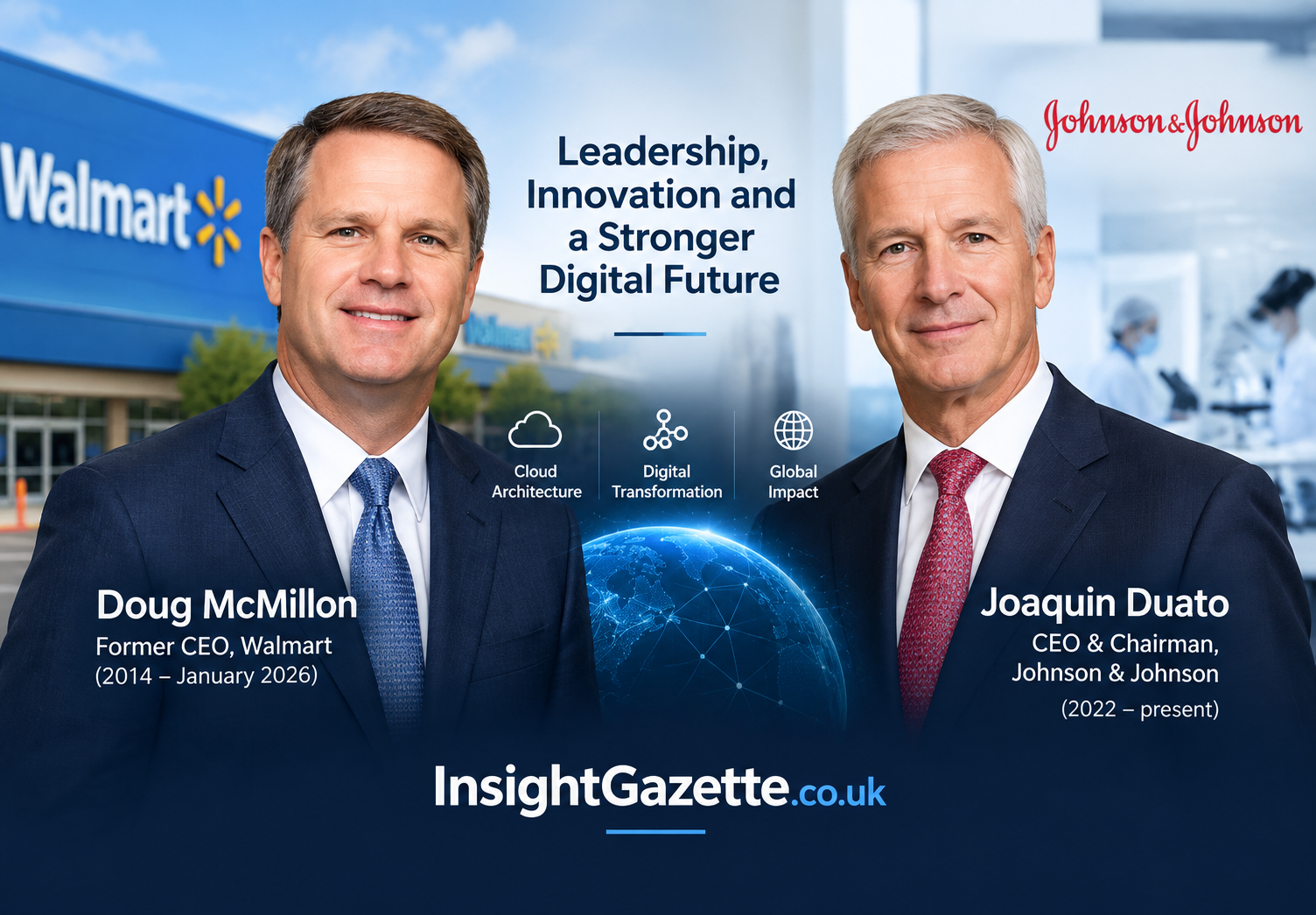
Doug McMillon and Joaquin Duato have led two very different global organizations through periods of major transformation. McMillon spent 2014–January 2026 as Walmart’s CEO, overseeing a shift toward a people-led, technology-powered omnichannel retailer. Duato became Johnson & Johnson’s CEO in 2022 and chairman in 2023, guiding a healthcare company focused on Innovative Medicine and MedTech. Their careers offer useful lessons in digital strategy, cloud architecture, operational scale, innovation, and organizational change.
Who Are Doug McMillon and Joaquin Duato?
Doug McMillon built his career inside Walmart, beginning as an hourly associate in 1984 before eventually becoming CEO. During his CEO tenure, Walmart expanded its e-commerce capabilities, modernized its supply chain, invested in technology, and developed an increasingly integrated physical-and-digital retail model. He retired as CEO on January 31, 2026.
Joaquin Duato has spent nearly four decades at Johnson & Johnson, working across geographies, functions, and business segments. He became CEO in January 2022 and chairman in January 2023. Today, his leadership is associated with Johnson & Johnson’s focus on Innovative Medicine and MedTech and six major areas of unmet medical need: oncology, immunology, neuroscience, cardiovascular, surgery, and vision.
Although their industries differ substantially, both executives operated in environments where technology, data, global operations, and organizational adaptability became increasingly important.
A Comparison of McMillon and Duato
| Area | Doug McMillon | Joaquin Duato |
|---|---|---|
| Organization | Walmart | Johnson & Johnson |
| Industry | Retail and e-commerce | Healthcare, pharmaceuticals and MedTech |
| CEO period | 2014–January 2026 | 2022–present |
| Career path | Long-term Walmart career | Long-term Johnson & Johnson career |
| Transformation focus | Omnichannel retail, supply chain, digital commerce | Healthcare innovation, portfolio focus, technology |
| Technology role | E-commerce, data, automation and digital customer experiences | AI, data science, digital technologies and healthcare innovation |
| Operating challenge | Huge transaction volumes and complex retail logistics | Scientific innovation, regulation and global healthcare delivery |
The comparison illustrates an important cloud architecture principle: technology strategy must reflect business requirements. A retail platform may prioritize extremely high transaction volumes and real-time inventory, while a healthcare organization may place greater emphasis on data governance, security, regulatory requirements, research workloads, and scientific computing.
McMillon’s Walmart Transformation and Cloud Architecture
One of the defining elements of McMillon’s Walmart tenure was the company’s movement toward a technology-enabled omnichannel model. Walmart described the transformation as becoming a “people-led, tech-powered” retailer, with investments in e-commerce, supply chain modernization, and customer and associate experiences.
From a cloud architecture perspective, a retailer operating at Walmart’s scale requires highly distributed systems. Consider a simple customer journey: someone searches for a product online, checks availability, places an order, receives an updated delivery estimate, and later collects the purchase from a store.
Behind that experience can be a network of APIs, databases, inventory systems, recommendation engines, payment services, logistics platforms, analytics pipelines, and mobile applications.
A modern architecture could separate these functions into independently scalable services. During a major shopping event, for example, product-search infrastructure might require significantly more capacity than an internal reporting application. Cloud-native architecture makes that type of elasticity possible.
Duato and Technology in Modern Healthcare
Joaquin Duato’s leadership context is fundamentally different. Healthcare technology has to support innovation while handling sensitive information, complex scientific workflows, and substantial regulatory requirements.
Johnson & Johnson identifies AI as an important technology for accelerating progress and describes a workforce combining technology with professional expertise. The company’s leadership has also emphasized data science, intelligent automation, and digital capabilities.
For cloud architects, healthcare presents a useful example of why technology modernization cannot simply mean “move everything to the cloud.” A well-designed healthcare environment needs identity controls, encryption, auditability, data classification, resilient infrastructure, and carefully governed access.
Research workloads can also benefit from scalable computing. Instead of permanently maintaining infrastructure for occasional computational peaks, organizations can use elastic environments for appropriate workloads while retaining strict governance over sensitive information.
What Their Careers Teach About Scalability
Scalability means more than adding servers. It means designing an organization and its technology systems so that growth does not cause proportional increases in complexity or operational risk.
For a company such as Walmart, scalability can involve millions of customer interactions, extensive supply-chain operations, store networks, digital platforms, and large volumes of operational data.
For Johnson & Johnson, scalability may involve global research programs, manufacturing, clinical development, medical technologies, and data-intensive innovation across multiple business areas.
The architectural lesson is straightforward: design for variable demand rather than today’s average demand.
Technologies such as containers, managed databases, serverless computing, event-driven architecture, content delivery networks, and automated infrastructure can help organizations scale specific components independently.
Security and Governance at Enterprise Scale
Security becomes increasingly important as organizations become more digital.
A retail cloud environment must protect customer accounts, payment-related information, employee systems, proprietary data, and operational infrastructure. A healthcare environment introduces additional considerations surrounding research data, patient information, intellectual property, medical systems, and regulatory obligations.
A strong enterprise security model can use zero-trust principles, least-privilege access, multifactor authentication, encryption, centralized logging, automated threat detection, and continuous compliance monitoring.
The key lesson is that security should not be added after deployment. It should be incorporated into architecture from the beginning.
For beginners, this can be understood through a simple analogy: rather than building a house and installing locks afterward, secure cloud architecture designs the doors, locks, alarms, access permissions, and monitoring into the original structure.
Cost Optimization and Business Value
Cloud technology can create substantial business value, but cloud adoption does not automatically reduce costs.
A poorly designed cloud environment can produce unnecessary spending through oversized virtual machines, excessive data transfer, duplicated storage, inefficient databases, and resources that remain active without meaningful workloads.
Enterprise architects therefore need FinOps practices that connect technical consumption with business value. Workloads should be monitored, capacity should be adjusted, and expensive services should have measurable purposes.
McMillon’s retail environment demonstrates the importance of efficiency at enormous operational scale. Duato’s healthcare environment illustrates another dimension: investment must support innovation, research, technology, and long-term organizational capabilities.
In both cases, the relevant question is not simply “How much does the cloud cost?” but “What business outcome does this infrastructure enable?”
Practical Use Cases for Modern Enterprise Architecture
The leadership stories surrounding Doug McMillon and Joaquin Duato can be translated into several practical cloud use cases.
For retail, an omnichannel platform can connect online catalogs, store inventory, fulfillment centers, customer applications, payment services, and delivery systems. Event-driven architecture can distribute updates when inventory changes, while analytics platforms can process customer and operational data.
For healthcare and life sciences, cloud platforms can support research analytics, scientific computing, collaboration, data processing, and selected AI workloads. Strong identity management and governance are essential because healthcare organizations operate under demanding privacy and regulatory expectations.
The architecture differs, but the principle remains consistent: technology should be designed around the organization’s actual operating model.
Leadership, Innovation, and Organizational Change
Technology transformation is ultimately an organizational challenge as much as a technical one.
McMillon’s long Walmart career gave him experience across different parts of the retail organization, while Duato developed experience across Johnson & Johnson’s functions, geographies, and business segments.
That kind of cross-functional experience matters because enterprise transformation affects finance, operations, technology, employees, customers, suppliers, and regulators simultaneously.
Cloud migration provides a good example. Moving applications without changing inefficient processes can simply reproduce old problems on new infrastructure. Successful modernization typically combines technology changes with redesigned workflows, stronger data practices, employee training, and clear governance.
Future Trends: AI, Data Platforms, and Intelligent Automation
AI is becoming increasingly connected to enterprise cloud architecture. Walmart’s current leadership has emphasized AI, digital platforms, data-driven decision-making, and technology-enabled retail transformation following McMillon’s retirement.
Johnson & Johnson likewise identifies AI and technology as important elements of its approach to innovation.
The next stage of enterprise architecture is therefore likely to involve more intelligent automation, real-time analytics, specialized AI infrastructure, data products, and increasingly sophisticated governance.
However, organizations will still need human oversight. AI systems depend on data quality, appropriate controls, reliable infrastructure, and clearly defined business objectives. The strongest architectures will combine automation with accountability rather than treating technology as a replacement for organizational judgment.
Frequently Asked Questions
1. Who is Doug McMillon?
Doug McMillon is a longtime Walmart executive who served as the company’s president and CEO from February 2014 through January 2026. He began his Walmart career as an hourly associate in 1984.
2. Who is Joaquin Duato?
Joaquin Duato is chairman and CEO of Johnson & Johnson. He became CEO in January 2022 and chairman in January 2023 after a long career across the company’s businesses and geographic markets.
3. What industries do McMillon and Duato represent?
McMillon’s career is primarily associated with retail, e-commerce, supply chains, and digital commerce. Duato leads a healthcare organization focused on Innovative Medicine and MedTech.
4. What do their leadership careers have in common?
Both developed extensive experience inside large global organizations and operated during periods of significant technological and organizational change. Their industries differ, but both environments require scalable infrastructure, data-driven decision-making, innovation, and strong operational governance.
5. Why are their careers relevant to cloud architecture?
Their organizations demonstrate two different applications of enterprise technology. Retail requires highly scalable digital commerce and supply-chain systems, while healthcare requires secure, governed infrastructure supporting research, innovation, and complex global operations.
Conclusion
The stories of Doug McMillon and Joaquin Duato demonstrate how technology transformation depends on more than adopting new software or moving applications to the cloud. McMillon’s Walmart tenure shows the importance of connecting digital commerce, physical operations, supply chains, data, and customer experiences at enormous scale. Duato’s Johnson & Johnson leadership illustrates how technology and AI can intersect with healthcare innovation, scientific expertise, and highly governed environments.
For cloud architects and business leaders, the broader lesson is practical: build infrastructure around business objectives, design for scalability, make security foundational, monitor costs, and treat data as a strategic asset. As AI, automation, and cloud-native technologies continue to evolve, organizations that combine technological capability with thoughtful leadership and disciplined governance will be better positioned to manage increasingly complex digital environments.